Showing posts with label history. Show all posts

Monday, March 12, 2018

Lower-Class

I've spent a significant amount of my time these past three years in researching my family history, which includes studying American history. How could it not? Many books have helped me along the way, some of which I've noted previously, and here's another one that rakes the muck from one's eyes: White Trash: The 400-Year Untold History of Class in America by Nancy Isenberg.

BRILLIANT. RIVETING. DISTURBING.


Now, granted, every author has their own agenda when writing a book, whether it is fiction or non-fiction, because each of us is seated within the context of our own lives and culture. That should go without saying, but it seems to be a missing piece of modern dialogue ... so I say it upfront. Nevertheless, I found Isenberg's White Trash riveting.

Using class as the lens through which to view American history opens up an important perspective regarding the society we live in now. It's easy to say "oh, sure, we all know that the poor have been and are looked down upon" but this book brings the reality home in a more visceral and disturbing way. We need to see and FEEL the shadow side of our own history if we want to continue evolving our society for the betterment of all humans, all life.

Most of us were taught the pretty image of the first colonists in Virginia and Massachusetts, those seeking religious freedom or increased fortune. And, yes, they comprised a portion of the early population, although some statistics reveal them as less than fifty percent of settlers. The rest? They represented "England's opportunity to thin out its prisons and siphon off thousands; here was an outlet for the unwanted, a way to remove vagrants and beggars, to be rid of London's eyesore population." These were children as well as adults. The indentured masses were fodder, most of their offspring filled the same niche.

I'm an American mutt with a solid 350-years of ancestral footprints embedded in the soil of this continent. My roots go deep, the bones of thousands of my ancestors are buried here, their blood spilled across the land as they toiled, migrated, gave birth, fought, and died. Many of those ancestors are the ones that the elites and upper-classes would have referred to as white trash, rubbish, rednecks, hillbillies, and more. As time and settlement expanded, I would guess they were often like the individual who "though coarse and ragged in his dress and manners ... at times described as hospitable and generous, someone who invited weary travelers into his humble cabin. Yet his more favorable cast rarely lasted after the woods were cut down and settled towns and farms appeared. As civilization approached, the backwoodsman was expected to lay down roots, purchase land, and adjust his savage ways to polite society--or move on." Unfortunately, many of these woods-families couldn't afford to buy the few acres they had been living on, barely getting by. I can imagine this is one of the reasons my ancestors came to Missouri when it was opened up to homesteading in the early 19th century -- it was their chance to own land, even if some of it was thick woods on rocky ground suitable only for subsistence farming.

For hundreds of years, if one didn't own land or property, you were inferior. As Isenberg sums it up: "The British colonial imprint was never really erased either. The 'yeoman' was a British class, reflecting the well-established English practice of equating moral worth to cultivation of the soil." How is that reflected in our so-called modern society?

This book provides a wealth of insight about the American class system that has been present from the beginning and still exists, whether we want to see it or not. Surely we can do better.

Monday, September 11, 2017

Ozarks Folklore

With the arrival of cooler temperatures, I'm starting to delve into research for my book of family history again. Even though I feel a lot more energetic physically when autumn arrives, I also feel the coming of hibernation time, and that leads me into project mode and the sense that active family history gathering -- genealogy as well as culture, stories, and history -- has sat on the sidelines long enough.
native Poke weed in background
"Boiled poke root used to be a famous remedy for itch, but 'it burned like fire, and the cure was probably worse than the ailment.' A strong ooze of pokeberry root, [a man said] 'will make you think hell aint a mile away, but it sure does cure the eetch.'"
Two of the most well-known old books about the Ozarks are quite different. The first is Ozark Magic and Folklore (formerly titled Ozark Superstitions) published by Vance Randolph in 1947 and based upon stories he obtained throughout the Ozarks of Missouri and Arkansas (the above quote is from this compilation). Some of the material was gathered together from other sources going back to 1927, while other portions came from the author's own interactions as he says:
"I first visited the Ozark country in 1899, and since 1920 I have spent practically all of my time here, living in many parts of the region, sometimes in the villages and sometimes in the wildest and most isolated 'hollers'. I fished and fought and hunted and danced and gambled with my backwoods neighbors ...." 
I've delighted in reading Randolph's book, even when he is being subtle in his condescension or derision. Much of the herbalism described has now been proven effective based upon scientific research, and some of the superstitions are familiar from my own elder relatives when they were alive. I also found some of the information to be similar to that of the folklore of Appalachia; no surprise since a good portion of the Ozarks settlers' families and ancestors came from that part of the country back in the early 19th century. One aspect that surprised me was that many of the so-called superstitions about weather relied heavily upon the astrological signs; the reliance upon lunar cycles was no surprise as many cultures followed the waxing and waning, the light and the dark cycles, but until now, I'd never heard of Ozark references to following what sign the moon or sun were in.

Some habits in the backwoods possibly harken back to Celtic beliefs (not surprising since most people in these parts have strong links to a Scots-Irish heritage) such as:
"A woman ... told me that ghosts and spirits are accustomed to stand about near cabins at night, and it is dangerous to offend these supernatural beings by throwing dirt in their faces. Sweepings are best gathered up and carried out of the house ...."
Remind anyone of the Little People of Ireland and Scotland? That said, the land which was taken over had once been part of the Osage Nation and they, too, had stories of "little people" of the woods.

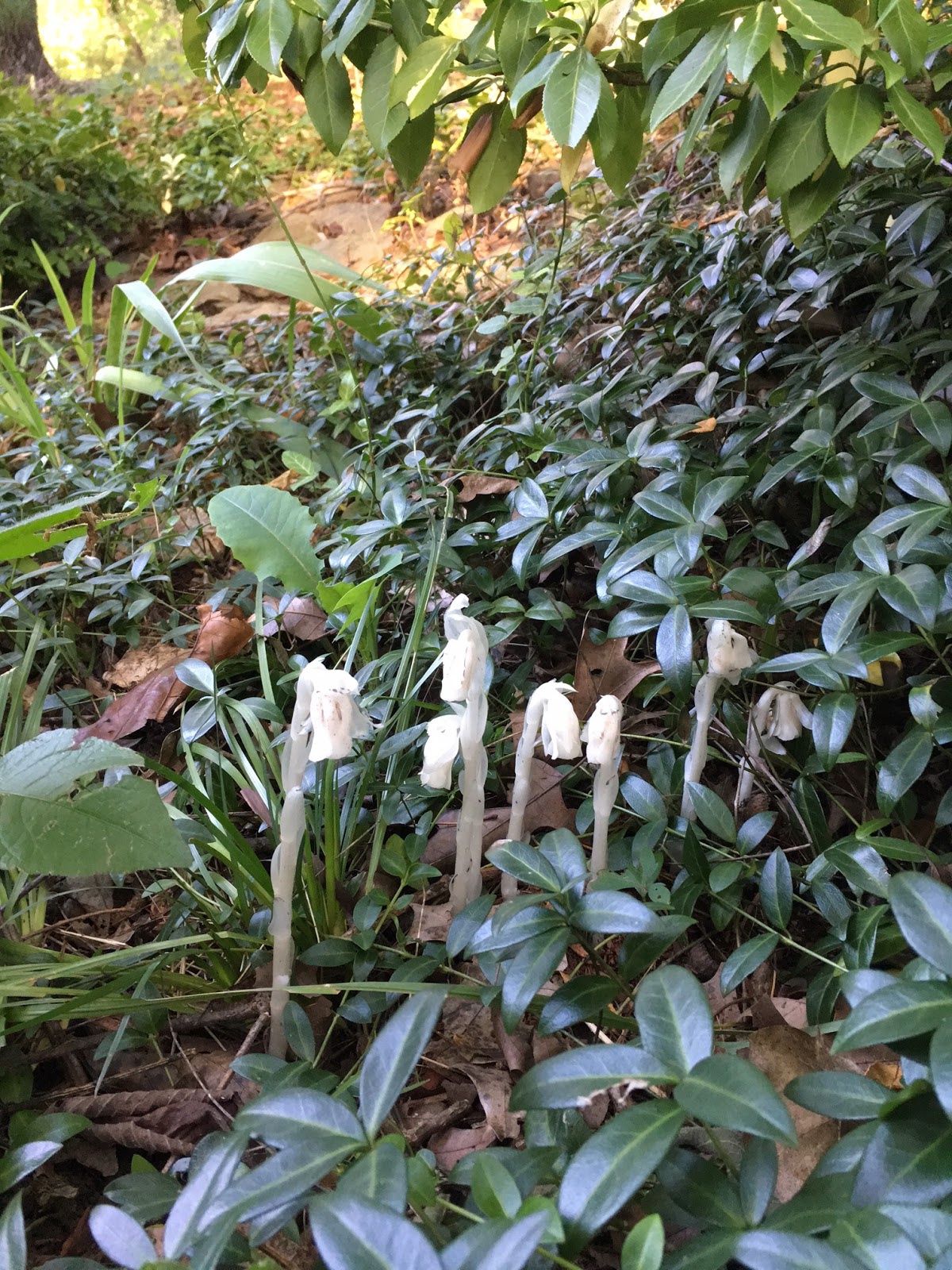
Indian Pipe flower
The second book that is, or used to be, notable about the Ozarks is The Shepherd of the Hills, published by Harold Bell Wright in 1907. (The book can be downloaded for free; the movie made in the 40s can be viewed HERE.) This one is a novel, and, as far as I can find, it's the first novel written that was set in the Ozarks (here's a list of more novels set in the Ozarks, though nearly all of them are relatively recent in publication). Starting in 1959, an outdoor drama based upon the book ran nearly continuously until recently; my parents and grandparents took us kids to see it, although I can't recall what year (likely around 1970). This is the closest full-length tale we have to a sort of modern Ozarks myth, although some legends have been retained as well as ghost stories passed along.

As my research continues, I'm realizing that this place where my family has lived for over 150 years has a lot of fascinating history, some quite tragic, and I find myself eagerly scrabbling online to find out more. What's great is that bits and pieces of what I find can be incorporated into my book on family history so that future generations can catch a glimpse of it.

Tuesday, August 22, 2017

Leave or Remove?

Even prior to the tragedy in Charlottesville, Virginia, where Heather Heyer was killed by a domestic terrorist, Americans had been arguing over whether Confederate statues ought to be removed. Like many of us, I have done a lot of reflection about this issue, getting emotional while also thinking it out, combining heart and mind.
I’ve come to the conclusion that it’s unlikely removal will solve anything. The divide in our country right now will only become more inflamed when a portion of our citizens feel that even more is being taken away from them than before. Even if people on the other side (and it feels wrong to keep putting us on opposing “sides” -- we're all Americans here) feel it is the right thing to do, the very action of taking away only adds to a mental anguish around scarcity. We need to encourage conversation around these memorials by perhaps adding statues and plaques that represent why the Confederate statues are there, how they came to be there, and also why they need to be symbols of a history we are moving beyond. When we finally reach the point where we can discuss putting them in an historical museum without violence and strident protests, then we will know it is time to do so.

The following are four recent articles that were an additional influence on my coming to the above conclusion, and show some of my thought process.
The author (an ecofeminist and lawyer) of the blog post Southern Pride in a Time of Terror begins by citing all the things and qualities that give her pride in being a Southerner, from food to music to storytelling to resilience. Through her words, I felt a true appreciation for my own ancestors who were co-creators in building these southern traditions through their courage and strength. The author then went on to cite the aspects that are embarrassing or shameful, such as continued demands for slavery that contributed to the Civil War, and the later Jim Crow resistance to emancipation. I must own the fact that I also have ancestors who participated in that awful period of American history. Where I parted ways with the author, however, was in her vehemence to: “Tear down the Confederate flags and pull down each and every statue of Confederate soldiers on public land.” No, we shouldn’t be flying the flag of a group of people who were so caught up in their demands to be independent states (and maintain slavery as a way of life) that they lost sight of the goal for Union; but having a war against the symbols won’t change people’s mindsets. 
The author (a teacher of theology, psychology, and philosophy) of the essay On the Removal of the Confederate Statues cites a southern mayor and an historian with conflicting views; she comes to the conclusion that: “Keeping the statues in place supports rather than dissembles the power structure(s) the statues represent.” She would encourage that the statues be removed to historical museums; maybe that would be fine at some point, but not when we are in an inflammatory situation already because it is coming from a place of power, control over, and warrior ethic, rather than a public conversation. That’s why I appreciated a commenter who said that: “What if the statues to confederate leaders were not removed but monuments that tell the other side of the story were erected alongside them? … What if our whole denied and suppressed history was on display in the public square, the genocide of native peoples as well as slavery?” And that is where my own thoughts reside; we need the whole story out in public, not in museums (not yet anyway), but instead encouraging at the very least a visual dialogue in public spaces. We cannot skip steps in the healing of our Nation.
The author (a professor of anthropology) of the article I detest our Confederate monuments. But they should remain., provides another perspective. He comments on the terrible destruction of statues and relics throughout world history, how it solves nothing. He says that, “People effectively act as though destruction of a monument exorcises its power and removal banishes the power from their midst. But these pieces of metal and stone only have the meaning we assign to them, and that meaning can take any form we like. They can be revered or reviled; honored or ridiculed; or co-opted for a new purpose.” This is vital to realize, and he continues with stating that, “destroying monuments takes a page out of the playbook of mobs across the centuries, lowering one’s self to that moral plane.” He continues: “When racists revere these monuments, those of us who oppose racism should double our efforts to use these monuments as tools for education.” He finishes with what I consider to be a powerful statement: “Destroying or removing monuments is the easy way out of our obligation to understand our past and improve our future. Monuments to our nation’s racism can be as much a tool to counter it as they can be a tool to foment it. The choice and obligation is ours.” 
Lastly, there are multiple web sites posting the same article, but claiming authorship for the article titled: “Here's what Robert E. Lee thought about Confederate monuments.” I’ve no idea which one is the original source, but all use what are apparently comments in Lee’s letters to various people after the Civil War. Lee apparently wrote that Confederate monuments would retard the ability of the country to recover, he wished that battlefields be “erased from the landscape altogether” (according to biographer Horn), and he didn’t want the flag flying at the college where he taught; it seemed Lee felt these would remain “divisive symbols” and wanted nothing to do with them. Unfortunately, the symbols are still standing and flying, so we have to find a way to deal with them — and learn from our mistakes — without in-fighting and tearing each other apart.
I happen to believe that all memorials to wars in any shape or form need to be done away with eventually, that all they seem to do is promote the celebration of aggression and make heroes and/or martyrs or those who killed and died, with a focus on nationalism, disregarding the rest of humanity that suffered or is suffering. 

Friday, June 30, 2017

Small Town, Big History

I recently returned from a two-night getaway with a good friend, something we have done in the past. We wanted to find a quaint walking-town that would be conducive to good conversation and exploring interesting sights. We decided on Hermann, Missouri, a town in Gasconade County established by German immigrants in the mid-nineteenth century.

We had one full-day to explore and spent a good part of our time touring the Deutschheim State Historic Site, Stone Hill Winery, and Hermann Farm (a type of living history museum). All of these were marvelous experiences!

During our tour of Hermann Farm, we were taken around the property in a wagon where we periodically got off to visit renovated and reconstructed buildings, make friends with the Shire horses, and view the country side up close. At the top of a hill, from the old cemetery, we were afforded a magnificent view of Hermann where it borders the Missouri River.


One thing our guide pointed out is how much the flow of the river has changed since Hermann's creation. Her grandparents remarked that at times back then the Missouri River was much more broad and could sometimes be crossed by a team of horses pulling a wagon; however, "civilization" has resulted in a deeper, more narrow river.


Our visit to the Deutschheim State Historic Site provided us with a glimpse into the lives of the German immigrants. They were woodworkers as well as vineyard owners; most of them were relatively well-off for the time period, building beautiful homes that have withstood the tests of time. This isn't to deny that they all had to work very hard because this was, after all, a wilderness. The Germans used to transform flax into linen; the "tail" seen (on the right) in the photo is spun flax. I've seen lots of displays and demonstrations about the process of spinning wool or cotton; this was the first time I'd seen one on flax.


Because some of my own ancestors lived in Gasconade County at one time, though none in the town of Hermann (as far as I know), and because I've been doing a lot of genealogical research on my family, I was particularly interested in the map on display that provided an overview of ethnic immigration and settlement patterns in Missouri.


The place I particularly wanted to visit while in Hermann, however, was the Stone Hill Winery. I was fascinated, not by the wine, per se, but by the underground wine cellars (those photos online are much better than any I managed to get) that had taken the original owner 22 years to carve out of the limestone (by hand, mind you, starting in 1847 -- it remains the largest underground system of cellars in North America) and the unusual history of Stone Hill. The historical images HERE show the remarkable size of the arched stone cellars and the large casks in use at that time.

This large cask was not one used at Stone Hill
Winery, but was on display in the
Deutschheim.
As the story goes: 
"By the turn of the century, Stone Hill Winery, which the German immigrant Michael Poeschel began building in 1847, was the third largest winery in the world (second largest in the U.S.), producing more than a million gallons of wine a year. Its wines, such as Hermannsberger, Starkenberger and Black Pearl, won eight gold medals at world fairs between 1873 and 1904."
I have become fascinated by the history of Missouri Wine--specifically Stone Hill Winery and others in Hermann--and will probably delve into the topic further.

All in all, my little trip to Hermann, Missouri, was absolutely wonderful. I look forward to returning and, if you're ever driving between St. Louis and Kansas City, I encourage you to stop in Hermann.


Wednesday, May 10, 2017

Celtic Family Roots

Carnac in Brittany, 1909

I have ancestors with Celtic connections on both sides of my family tree. Most Americans whose families have been here for 350 years probably do as well. Of my ancestors who I’ve been able to trace back to country of origin, there were 59 (at last count) who emigrated from the Celtic locales of Scotland, Ireland, and Wales, alas none from Brittany (in context, there were 208 from England, the clearly predominant country, with a smattering from countries on the continent including Germany, the Netherlands, Sweden, Switzerland, Denmark, and France, plus a few drops of Native American mixed in for good measure).
My primary fascination with the Celts is due to their visceral and spiritual link
to the landscape, one that I resonate with, as well as their belief in a mysterious parallel dimension, referred to as the Otherworld, inhabited by fairy-folk. On the other hand, the Celtic aspect completely alien to me is that they were renowned as a warrior culture; I definitely didn’t receive those genes. I also try to extricate Celtic women’s past out from under the heavy weight of the patriarchal times and mythologies (since the 1970s, thankfully, many other women have been absorbed in this effort as well so I have plenty of guides). Unfortunately, most non-mythological records focused on battles and wars; that’s what interested most men and they wrote the histories, so one has to peek between the lines to find cultural nuggets beyond those limitations.
The Baker family tree on my mother’s side reveals a robust blend of Celtic lineage. My great-grandmother Rosetta Jane Baker’s line contains 10 individuals from Scotland, 5 from Wales, and 7 from Ireland (possibly Scots-Irish, based upon the time period of emigration; further research would be needed to verify), a few of which I’ll mention here.
© Trustees of the British Museum
According to an online genealogy resource for the Baker family, it is said that, “The dark rolling moors of the Scottish/English border are home to the notable surname, Baker. Its ancient history is closely woven into the rich and beautiful tapestry of the border chronicles” and that the family motto is “Dum spiro spero. (While I have breath I hope.)” The theory is that the Baker name and family descended from the northern mix of Scottish Picts and Angles (about 400-1000 CE). That adds in the intriguing history of the Picts, current theory emerging that they were the “indigenous population,” the original inhabitants, for that part of the world.
My 4th-great-grandparents were James and Rebeckah (Small) Baker; their families were from Kentucky, and previous to that, Virginia in the 18th century. I am still trying to unearth the definite direct link for James Baker, but it was recorded in 1889, in a county historical tome, that his wife Rebeckah Small was of Irish descent. This statement is a curious puzzle, however, since most of my research points to the Small ancestors (plus the Burnett and Henderson wives in that family tree) as being from Scotland; immigrant John Small was born in 1716 in Kilmarnock, Ayrshire, Scotland (southwest of Glasgow, though he could have Irish roots) and the others in the northeast lands of Aberdeen and St. Andrews (both are northeast of Edinburgh). James and Rebeckah’s son Hiram married Clarisy Maddy, and her family line brought in some Welsh through the Morris lineage.
This indomitable Celtic family line gradually traversed America from Virginia, then to Kentucky and Tennessee, before finally arriving in Missouri in the mid-19th century. There’s a generational story here, one of many, just waiting to be told!
My husband doesn't really understand my recent interest in ancestors and cultural family history. I tell him it's not that I think this knowledge will change me--life is good and I like who I am--but rather that it does seem to help me understand myself a bit better. Plus, I've always been curious and a seeker, learning is fun for me, and "visiting" my ancestors or ancestral cultures is also a way to honor their journey.

Thursday, May 4, 2017

Theories of History and Pre-History

As I get further into researching Celtic history, for both my family genealogy book and a future novel, there are contrasting theories (I mentioned a little of this in an earlier post HERE). Lo and behold, in an older (1975) book titled The Celts: The People Who Came out of the Darkness by Gerhard Herm, the author doesn't even pretend to have all the answers. Refreshing!


Herm states at one point, referencing an amateur being derided by experts, that even those so-called experts "have had to admit that they were themselves guilty of bias" toward the amateur who, they said had "a tendency to tailor pieces of prehistory to fit his own ... theory."

Herm then goes on to explain that:
"This practice [of tailoring] is not, however, uncommon, even among reputable scholars. Indeed, used in moderation, it is quite legitimate. It is rather like trying to do a jigsaw that refuses to come out by starting at a different corner. If it works, so much the better. If it fails, the attempt should not be condemned out of hand but should be classed among the many models that have, over the years, been set up only to be knocked down again. Indeed many useless hypotheses belong among those sorts of wrong answer that must be given so that we can know why they are wrong." 
Further, Herm states that:
"The existing facts have grown into such a mountain that a survey would take a whole lifetime, without guarantee of result. Hypothesis has to be our core-sampler: with it we can probe the mountain, in the hope of being rewarded with unexpected insight. I have in what follows had occasion to use such methods, and studies whose arguments, though plausibly founded, cannot be conclusively proven. At best the result will be a picture that ought to be looked at with caution: this is how it might have been. If it was not, no doubt we shall one day find out."
I would personally step back from even the optimism of that last sentence. For one reason, because the "facts" used are often not facts themselves but interpretations and theories. Secondly, I do like his cautionary approach, but would view the theories as likely to remain in the realm of "this is how it might have been." Herm doesn't address this once, but regularly throughout his book, like when trying to find the answer to a particular question, he writes that, "to answer it we must persist with hypotheses and the sparsest evidence." I truly did find his openness to possibility delightful.

I'm glad that I've placed Herm's older book at the top of my reading list, for it more easily lends itself to later thoughts and ideas.

Saturday, April 29, 2017

History of the Celts ... and what may have been before

I find history fascinating. What I don't find in history is certainty. Unlike many who study history (or anthropology or archeology), I see it quite simply as interpretation. Even written history is often only that which was recorded by the dominant culture and how they perceived what they were observing (since the records of those who were subjugated were often destroyed); this is easily realized when we consider how Europeans misinterpreted so much about Native American culture. If those confusions arose only several hundred years ago, all of it "documented," then it is quite easy to see how confusing history can be going back even further in time.

As I research Celtic history, I find repeatedly that each person is determined to make their interpretation one of fact. During the past years, it seems, there has been a lot of uproar regarding the identification of whether one is genetically "Celtic," but we can no more isolate our genes and DNA than we can our veins and heart. There is even dispute on whether Celtic societies were actually established in Ireland, Wales, Brittany, and Scotland, primarily because of modern linguistics; again, we can only see through a glass darkly on this or any other historical so-called definitive interpretation. I enjoy the research; I appreciate the tremendous effort involved. However, I see the endeavors as portals into what might have been, not what was (as fact), and in this undertaking to find out more about ourselves.

For me, the Celtic legacy remains its culture as a whole, not its parts as isolated components to substantiate whether someone is right or wrong. The whole view, individually interpreted, is what has the potential for helping humanity achieve greater good for every being. In other words, what in this legacy can help us lead better, more balanced lives?

That is the angle I come from, whether in my personal genealogical and family tree research, or in the fictional history of the characters in my novels. In other words, how might Celtic culture have shaped the people of the past? What might I learn from the bits gathered together into various patterns?
Related Posts Plugin for WordPress, Blogger...