Showing posts with label research. Show all posts

Monday, March 12, 2018

Lower-Class

I've spent a significant amount of my time these past three years in researching my family history, which includes studying American history. How could it not? Many books have helped me along the way, some of which I've noted previously, and here's another one that rakes the muck from one's eyes: White Trash: The 400-Year Untold History of Class in America by Nancy Isenberg.

BRILLIANT. RIVETING. DISTURBING.


Now, granted, every author has their own agenda when writing a book, whether it is fiction or non-fiction, because each of us is seated within the context of our own lives and culture. That should go without saying, but it seems to be a missing piece of modern dialogue ... so I say it upfront. Nevertheless, I found Isenberg's White Trash riveting.

Using class as the lens through which to view American history opens up an important perspective regarding the society we live in now. It's easy to say "oh, sure, we all know that the poor have been and are looked down upon" but this book brings the reality home in a more visceral and disturbing way. We need to see and FEEL the shadow side of our own history if we want to continue evolving our society for the betterment of all humans, all life.

Most of us were taught the pretty image of the first colonists in Virginia and Massachusetts, those seeking religious freedom or increased fortune. And, yes, they comprised a portion of the early population, although some statistics reveal them as less than fifty percent of settlers. The rest? They represented "England's opportunity to thin out its prisons and siphon off thousands; here was an outlet for the unwanted, a way to remove vagrants and beggars, to be rid of London's eyesore population." These were children as well as adults. The indentured masses were fodder, most of their offspring filled the same niche.

I'm an American mutt with a solid 350-years of ancestral footprints embedded in the soil of this continent. My roots go deep, the bones of thousands of my ancestors are buried here, their blood spilled across the land as they toiled, migrated, gave birth, fought, and died. Many of those ancestors are the ones that the elites and upper-classes would have referred to as white trash, rubbish, rednecks, hillbillies, and more. As time and settlement expanded, I would guess they were often like the individual who "though coarse and ragged in his dress and manners ... at times described as hospitable and generous, someone who invited weary travelers into his humble cabin. Yet his more favorable cast rarely lasted after the woods were cut down and settled towns and farms appeared. As civilization approached, the backwoodsman was expected to lay down roots, purchase land, and adjust his savage ways to polite society--or move on." Unfortunately, many of these woods-families couldn't afford to buy the few acres they had been living on, barely getting by. I can imagine this is one of the reasons my ancestors came to Missouri when it was opened up to homesteading in the early 19th century -- it was their chance to own land, even if some of it was thick woods on rocky ground suitable only for subsistence farming.

For hundreds of years, if one didn't own land or property, you were inferior. As Isenberg sums it up: "The British colonial imprint was never really erased either. The 'yeoman' was a British class, reflecting the well-established English practice of equating moral worth to cultivation of the soil." How is that reflected in our so-called modern society?

This book provides a wealth of insight about the American class system that has been present from the beginning and still exists, whether we want to see it or not. Surely we can do better.

Monday, January 22, 2018

The Feel of the Forest

Have been reading the 1905 book Spirit of the Mountains by Emma Bell Miles, of Tennessee (many of my ancestors, far more than half, migrated from Appalachian TN, KY, and NC to MO), and found this paragraph particularly resonant as well as lovely:
"We who live so far apart that we rarely see more of one another than the blue smoke of each other's chimneys are never at ease without the feel of the forest on every side--room to breathe, to expand, to develop, as well as to hunt and to wander at will. The nature of the mountaineer demands that he have solitude for the unhampered growth of his personality, wing-room for his eagle heart."

Monday, October 2, 2017

Going Deep

Since the publication of my first book in 2007, I have produced another one every 2-3 years. This timing felt about right, both creatively and situated as they were in my experiences and subsequent research (when needed). However, my latest projects require a lot more research -- at least, I think they do -- which is placing me in an oddly impatient and unfamiliar position!

The novel is edging closer and closer to its end, which means it will probably be the first to make it to publication. I've stopped giving myself a deadline, however, because I keep getting distracted by the other two interconnected manuscripts. Every book I've come across on writing advice states to not be working on more than one WIP at a time. Apparently, that particular suggestion has not sunk in on me.

The current memoir -- let's call it a historical memoir -- is quite a persnickety piece of work. I take comfort in this comment:
"Histories commonly have autobiographical significance as this one does, and like many narratives, it is the result of ongoing research conducted over several years until the authors finally paused to summarize their experience."
The authors, Morrow and Myers-Phinney, are professional historians responsible for the book Shepherd of the Hills Country: Tourism Transforms the Ozarks, 1880s-1930s, a wonderful resource for my own work.

The family history book I'm putting together is directly linked to my historical memoir, and both are going far deeper than I originally envisioned. In fact, they seem to be bottomless sinkholes at this point. This is, however, one of the choices I made when deciding to go beneath the surfaces of culture and the roots of genealogy into the Wilderness Underground. Caves are certainly an apt metaphor for where I seem to be going with my writing.


Thursday, September 14, 2017

A Classic Ozarks Tale

In direct opposition to the literary criticisms about The Shepherd of the Hills by Harold Bell Wright (published 1907), I found this tale captivating. Maybe that was partly because of my own cultural connection to it via family history in the same area, but for whatever reason, I could hardly put the book down until the end. I was surprised, no, shocked, at how much I enjoyed the story.  
For some reason, my memory of the outdoor drama based upon the novel (one I attended as a child), and the vaguely recollected comments of family members, focused upon the Christian aspects of the story. To my delight, however, the novel didn’t feel like a “Christian story” or even like a morality tale per se. On the contrary, the story was thoroughly entertaining, plus, the mystery and beauty of Mother Nature were expounded upon to depict the immanence of the Sacred. 
Essentially, the story revolves around a stranger from the city who arrives in the backwoods of the Missouri Ozarks about 1880/1890. He is welcomed by the hill folk and eventually integrates with them; our narrator refers to him as the shepherd.
I was enchanted by the unique character of Pete, an ethereal, fey boy who hears and talks with nature. In an early conversation with the shepherd, we are told: 
“Again that strange smile illuminated [Pete’s] face [and he told the shepherd]… ‘And the tree things like him, too, brother; and the flowers, the little flower things that know everything; they’re all a singing’ to Pete ‘cause he’s come … And the grey mist things come out and danced along the mountain, ‘cause they was so glad you come. … Do you like Pete’s people, Mister?’ He waved his hands to include the forest, the mountains and the sky; and there was a note of anxiety in the sweet voice as he asked again: ‘Do you like Pete’s friends?’” (Pages 38-39)
While Wright’s depictions of the characters are bigger-than-life, they didn’t feel like cheap stereotypes, rather, I was reminded of archetypes. The story seemed to express a resonance with a myth or a rustic fairy tale. 
For example, about the major female character, Wright wrote: 
“Sammy Lane knew nothing of the laws and customs of the, so-called, best society. Her splendid young womanhood was not the product of those social traditions and rules that kill the instinct of her kind before it is fairly born. She was as free and as physically perfect as any of the free creatures that lived in the hills. And, keenly alive to the life that throbbed and surged about her, her woman’s heart and soul responded to the spirit of the season. The droning of the bees in the blossoms that grew in a cranny of the rock; the tinkle, tinkle of the sheep bells, as the flock moved slowly in their feeding; and the soft breathing of Mother Earth was in her ears; while the gentle breeze that stirred her hair came heavy with the smell of growing things.” (Page 48)
Sammy, 19 years old and promised to a local lad who had left Mutton Hollow for an opportunity in the big city, was worried that he might find her wanting upon his return. With that in mind, she asked the shepherd to help her become a “lady” like her fiancĂ© would be meeting in the city. The shepherd, seeing the magnificent wild and free qualities in Sammy, hesitated, but decided to do his best to encourage her to merge the finest of who she already was with qualities that would allow her to fit in with so-called civilized city-people. He said “a real lady, Sammy is a lady in three ways: First in her heart.” Then, he says the second is to have a “lady mind” or, in other words, that “she must know how to think and talk about the things that really matter.” And thirdly, he says she should “keep her body as strong and as beautiful as she can, for this is one way that she expresses her heart and mind” but not because of what others might think, rather, “just for herself.” The shepherd greatly admires Sammy, already, as an example of splendid womanhood; he doesn’t want her to change but rather to grow more empowered. 
I will admit that there were times throughout the book where I became weary of Wright’s emphasis upon the perfection of both Sammy’s womanhood and Young Matt’s manhood. However, when viewed from an archetypal perspective, this is simply part of mythology, and through this lens (consider the men and women in Greek myths, for instance, or Snow White and Prince Charming, or even Eve and Adam in the Garden of Eden), their physical perfection makes sense.
When, toward the end of the book, the author included a reference to one of my least favorite passages in the Bible, the one about man having dominion over the earth, it jarred with the rest of the story’s message of equitable harmony with the earth. For instance, during one scene, the shepherd (once known as a pastor, a Doctor of Divinity, with the “biggest church, greatest crowds in the city” of Chicago): 
“Could not grasp the truth of the situation, but the beauty of the hour moved him deeply … ‘See how soft the moonlight falls on that patch of grass this side of the old tree yonder, and how black the shadow is under that bush, like the mouth of a cave, a witch’s cave. I am sure there are ghosts and goblins in there, with fairies and gnomes, and perhaps a dragon or two. And see, lad, how the great hills rise into the sky. How grand, how beautiful the world is!’” (Page 89)
And again, this relationship with the earth when the shepherd welcomed into his home an old friend, who remarked upon the change in him. The shepherd said: 
“‘I suppose I have changed some, David. The hills have done it. Look at them!’ He pointed to the encircling mountains. ‘See how calm and strong they are; how they lift their heads above the gloom. They are my friends and companions, David. And they have given me of their calmness and strength a little.’” (Page 159)
There are countless passages in the book where the author waxes poetic about the splendor of the Ozark mountains and the magic contained in a relationship with them. The shepherd wrote to his friend about the winsome boy Pete that: 
“‘Here and there among men, there are those who pause in the hurried rush to listen to the call of a life that is more real. How often have we seen them, David, jostled and ridiculed by their fellows, pushed aside and forgotten, as incompetent or unworthy. He who sees and hears too much is cursed for a dreamer, a fanatic, or a fool … Pete knew a world unseen by us, and we, therefore, fancied ourselves wiser than he. The wind in the pines, the rustle of the leaves, the murmur of the brook, the growl of the thunder, and the voices of the night were all understood and answered by him. The flowers, the trees, the rocks, the hills, the clouds were to him, not lifeless things, but living friends, who laughed and wept with him as he was gay or sorrowful.’” (Pages 177-178)
When I have time, I hope to do a close reading of the text and get further into its mythological themes. For now, I can say that I wholeheartedly recommend the book! 


As a side note, this book was a catalyst for making the Missouri Ozarks a tourist destination in the 20th century. I will write more about that later. Below is a nice map outlining the Ozark Plateau; the tale Shepherd of the Hills takes place near Branson (kind of middle left inside the circle).

Monday, September 11, 2017

Ozarks Folklore

With the arrival of cooler temperatures, I'm starting to delve into research for my book of family history again. Even though I feel a lot more energetic physically when autumn arrives, I also feel the coming of hibernation time, and that leads me into project mode and the sense that active family history gathering -- genealogy as well as culture, stories, and history -- has sat on the sidelines long enough.
native Poke weed in background
"Boiled poke root used to be a famous remedy for itch, but 'it burned like fire, and the cure was probably worse than the ailment.' A strong ooze of pokeberry root, [a man said] 'will make you think hell aint a mile away, but it sure does cure the eetch.'"
Two of the most well-known old books about the Ozarks are quite different. The first is Ozark Magic and Folklore (formerly titled Ozark Superstitions) published by Vance Randolph in 1947 and based upon stories he obtained throughout the Ozarks of Missouri and Arkansas (the above quote is from this compilation). Some of the material was gathered together from other sources going back to 1927, while other portions came from the author's own interactions as he says:
"I first visited the Ozark country in 1899, and since 1920 I have spent practically all of my time here, living in many parts of the region, sometimes in the villages and sometimes in the wildest and most isolated 'hollers'. I fished and fought and hunted and danced and gambled with my backwoods neighbors ...." 
I've delighted in reading Randolph's book, even when he is being subtle in his condescension or derision. Much of the herbalism described has now been proven effective based upon scientific research, and some of the superstitions are familiar from my own elder relatives when they were alive. I also found some of the information to be similar to that of the folklore of Appalachia; no surprise since a good portion of the Ozarks settlers' families and ancestors came from that part of the country back in the early 19th century. One aspect that surprised me was that many of the so-called superstitions about weather relied heavily upon the astrological signs; the reliance upon lunar cycles was no surprise as many cultures followed the waxing and waning, the light and the dark cycles, but until now, I'd never heard of Ozark references to following what sign the moon or sun were in.

Some habits in the backwoods possibly harken back to Celtic beliefs (not surprising since most people in these parts have strong links to a Scots-Irish heritage) such as:
"A woman ... told me that ghosts and spirits are accustomed to stand about near cabins at night, and it is dangerous to offend these supernatural beings by throwing dirt in their faces. Sweepings are best gathered up and carried out of the house ...."
Remind anyone of the Little People of Ireland and Scotland? That said, the land which was taken over had once been part of the Osage Nation and they, too, had stories of "little people" of the woods.

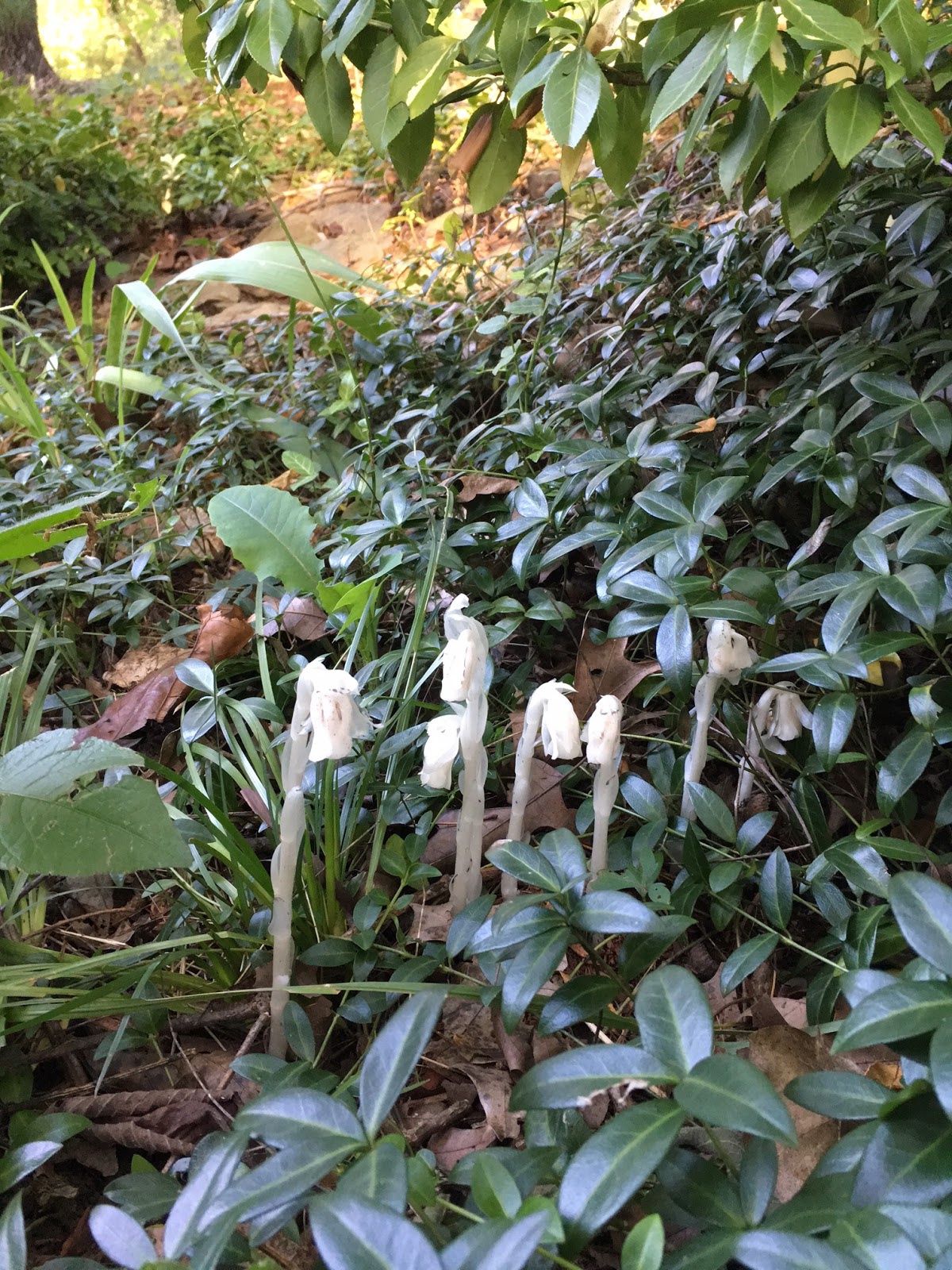
Indian Pipe flower
The second book that is, or used to be, notable about the Ozarks is The Shepherd of the Hills, published by Harold Bell Wright in 1907. (The book can be downloaded for free; the movie made in the 40s can be viewed HERE.) This one is a novel, and, as far as I can find, it's the first novel written that was set in the Ozarks (here's a list of more novels set in the Ozarks, though nearly all of them are relatively recent in publication). Starting in 1959, an outdoor drama based upon the book ran nearly continuously until recently; my parents and grandparents took us kids to see it, although I can't recall what year (likely around 1970). This is the closest full-length tale we have to a sort of modern Ozarks myth, although some legends have been retained as well as ghost stories passed along.

As my research continues, I'm realizing that this place where my family has lived for over 150 years has a lot of fascinating history, some quite tragic, and I find myself eagerly scrabbling online to find out more. What's great is that bits and pieces of what I find can be incorporated into my book on family history so that future generations can catch a glimpse of it.

Saturday, April 29, 2017

History of the Celts ... and what may have been before

I find history fascinating. What I don't find in history is certainty. Unlike many who study history (or anthropology or archeology), I see it quite simply as interpretation. Even written history is often only that which was recorded by the dominant culture and how they perceived what they were observing (since the records of those who were subjugated were often destroyed); this is easily realized when we consider how Europeans misinterpreted so much about Native American culture. If those confusions arose only several hundred years ago, all of it "documented," then it is quite easy to see how confusing history can be going back even further in time.

As I research Celtic history, I find repeatedly that each person is determined to make their interpretation one of fact. During the past years, it seems, there has been a lot of uproar regarding the identification of whether one is genetically "Celtic," but we can no more isolate our genes and DNA than we can our veins and heart. There is even dispute on whether Celtic societies were actually established in Ireland, Wales, Brittany, and Scotland, primarily because of modern linguistics; again, we can only see through a glass darkly on this or any other historical so-called definitive interpretation. I enjoy the research; I appreciate the tremendous effort involved. However, I see the endeavors as portals into what might have been, not what was (as fact), and in this undertaking to find out more about ourselves.

For me, the Celtic legacy remains its culture as a whole, not its parts as isolated components to substantiate whether someone is right or wrong. The whole view, individually interpreted, is what has the potential for helping humanity achieve greater good for every being. In other words, what in this legacy can help us lead better, more balanced lives?

That is the angle I come from, whether in my personal genealogical and family tree research, or in the fictional history of the characters in my novels. In other words, how might Celtic culture have shaped the people of the past? What might I learn from the bits gathered together into various patterns?

Monday, April 3, 2017

Mountain Essence

Even as I sink my roots into the Ozarks of Missouri, home of my birth and ancestors, I can't help but fantasize about the Rocky Mountains of Colorado. We vacationed there often, from the time I was 3, and moved there when I was 18; I ended up living along the Front Range and up in the mountains for 12 years. I adore the Rockies. If money were no object, I'd have a vacation home there right now. The next best thing is revisiting the mountains via memories, photos, and books. 

Is it any surprise, then, that my latest novel (the manuscript is finally complete in draft form) takes place in a fictional little town high in the Rocky Mountains? 

A curious trait of mine is that I remember the essence of past experiences more than the specific recall of details. This is where photos and books are the perfect resource; they provide the visual and I can then sense the location and imagine events. Indeed, one of the books I inherited from my dad is A Portrait of Colorado, published in 1976; it provides a delightful blend of photos, paintings, and essays. For instance, see that old mining shaft on the cover of that book? I swear I've been there because it evokes a sense of the mystery and history that was a part of my time in the Rockies.

Wednesday, April 13, 2016

Trusting the Discourse

In winter, we trust that spring will follow.
I find myself having to trust that my current discourse, whether face-to-face or through writing, is necessary. As I delve into culture, religion, politics, and family genealogy, it feels like I’ve fallen down Alice’s rabbit hole. I meant this exploration to be short-lived, a way to become more at ease during my transition to the Ozarks of Missouri where I’ve always felt like a square peg in a round hole. I expected that I could then quickly switch back to working on my novel, a work-in-progress that is about three-fourths complete. Instead, my inquiry process expands and contracts like a fire-breathing dragon, though, granted, this shouldn’t have been a surprise since the local community and our larger American society as a whole is, in fact, the result of complex people, alive as well as dead. 
History reaches forward as well as backward, and each moment of the present investigation compels me to seek an explanation, an origin, but one that never truly manifests as solid. The fear and anger of the American people is full-spectrum, derived from past disappointment and future expectation, compounded by myriad perceptions of how our lives should be — locally as well as globally. This, too, is part of the fieldwork and analysis applicable to all of us; I am within the spiral of events, yet also a witness to them.

Thus, what began as a form of personal therapy has developed into a desire for greater knowledge and, hopefully, deeper wisdom. I have to trust that there is a purpose to my seemingly endless research, encompassing both my inner and outer work, taking up vast amounts of time, and that it will ultimately benefit others as well as myself. And I have to trust that when I eventually return to working on my novel, that it will be enriched as well — perhaps its characters will be more alive and multi-faceted than they would have been without my detour into the quagmire of the American political and religious systems.

I end with Walt Whitman on "How Literature Bolsters Democracy" … certainly something to aspire to when writing! 

Sunday, January 12, 2014

Digging Up Character

One fun thing about writing a novel is the ability to explore all kinds of personalities, lifestyles, and occupations. I've mentioned before that my current fictional WIP has been morphing and expanding. With that evolution, I found myself diving further into the history of the protagonist's parents. I mean, maybe other writers do it differently (probably do), but I find it difficult to flesh out my lead character without knowing her past and the ghosts that may be haunting her.

In addition, since I'm envisioning this story as the first in a series, I want to start as I mean to continue, and that, for me, means understanding the forces that drive the characters.

This first book is seated in the "father story" of the protagonist. I didn't intend it to be this way, it just happened as I moved deeper into the storyline. With that in mind, I'm not only reading some psychology books on fathers and daughters--Daughters of Saturn, Leaving My Father's House, The Wounded Woman--I'm also reading some books that focus upon the career I gave the lead's father, including this one called Accidental Archeologist.

The previous two novels I've written were not as complex as this one, and I am enjoying the challenge--a challenge that would have sunk me earlier on.

This coming week, my second semester at UA starts, but for now … on with story-building!
Related Posts Plugin for WordPress, Blogger...